Venture Down Under 2026
For three days on the Gold Coast, Venture Down Under brought together the largest gathering of GPs in the region.

Around 180 venture leaders. International guests from five continents. More than 90% of the GPs across Australia and New Zealand represented in one place.
And one big question sitting underneath almost everything:
What future is Australia willing to build, and back, before anyone else can even see it?
That question started seriously.
It did not stay serious the entire time.
There were keynotes on national ambition, AI capability and productivity. There were debates about the future of venture capital, Australia’s place between East and West, and what this industry needs to become over the next decade.
There were also jet skis.
And pirates.
But more on that shortly.
The future does not just happen to Australia
Dr Larry Marshall opened VDU by challenging the room to think much bigger.
Drawing on a career spanning CSIRO, Main Sequence and decades of building technology businesses, Larry argued that the biggest opportunity is rarely simply finding another company to fund.
It is seeing a market before everybody else does.
“Technology solves pain. It solves problems. But market vision creates markets. And that’s where the value is.”
His challenge was wonderfully simple.
Stop spending so much time debating which future is most likely.
Ask what becomes inevitable.
Ask what is preventing it from happening today.
Then ask whether Australia can remove that bottleneck better than anyone else in the world.
And when the answer is yes:
“Don’t build a company, build an industry.”
Larry described Australian venture as entering its fourth generation. The job of this generation, he argued, is no longer simply to import the Silicon Valley playbook.
It is to create our own market vision.
Because, as he told the room:
“The future isn’t something that happens to Australia. It’s something that this room gets to decide happens for Australia.”
That idea became the thread running through VDU.
Then we turned to AI
Day two took the conversation directly into the technology reshaping almost every investment thesis in the room.
Professor Anton van den Hengel, founding director of the Australian Institute for Machine Learning, pushed hard against Australia’s instinct to play it safe.
His warning was clear.
If we spend this cycle building thin applications on top of somebody else’s models, we are building businesses whose advantage can disappear with the next model release.
“The value is in the capability layer, not the applications.”
And:
“Incremental AI is not advantage. The advantage in AI is capability.”
Then came one of the sharpest observations of the week.
“We’ve got great people, we’ve got great money. The problem is that we lack ambition.”
That line travelled.
Because the uncomfortable implication was obvious.
If Australia relies entirely on foreign AI capability, we begin the next technological cycle competing with one arm behind our back.
Conviction is the scarce resource
Across three days, the same message kept resurfacing in different forms.
Larry put it simply:
“Conviction is the scarce resource today.”
The East Meets West panel asked where geography still matters in a world where companies, capital and technology increasingly cross borders instantly.
Paul Bloxham brought the conversation back to Australia’s productivity challenge.
And again and again, the discussion returned to three things:
Conviction. Capability. Market vision.
Those may be the raw materials of the next decade of Australian venture.
And the people in that room have an unusually large role in deciding what gets built with them.
East meets West
One of the most fascinating conversations brought Silicon Valley, Asia and Australia onto one stage.
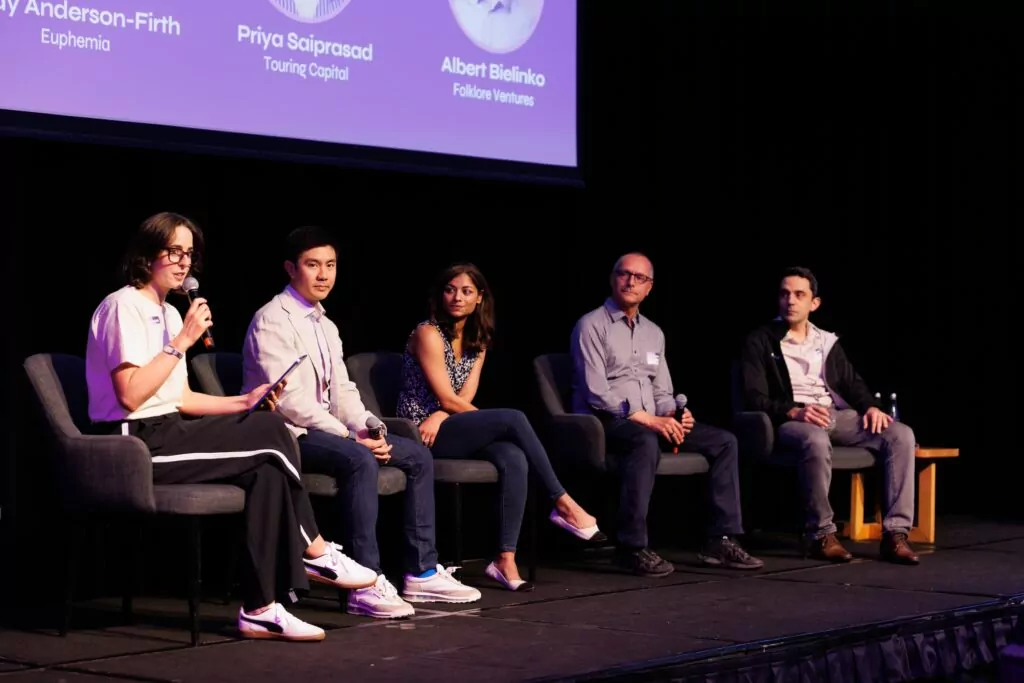
Moderated by Judy Anderson-Firth, the panel featured Bradley Horowitz of Wisdom Ventures, Priya Saiprasad of Touring Capital, Jonathan Yip from HSBC Innovation Banking and Albert Bielinko of Folklore Ventures.
The opening question was simple.
Will geography matter more or less over the next decade?
The room split almost perfectly.
50 / 50.
And the debate justified it.
Priya described a US market where:
“Bigger and bolder is really the sentiment du jour.”
Investors are increasingly underwriting enormous, potentially unbounded categories rather than building models around neat billion dollar exits.
Her advice on where durable opportunity might still hide was even better:
“Boredom is a moat in itself.”
Bradley captured just how extraordinary the mood around frontier AI has become by quoting Bill Gurley:
“The folks at Anthropic don’t believe they’re writing software. They believe they’re midwifing a deity.”
Jonathan brought the discussion home, positioning Australia at the intersection of East and West and particularly well placed in a cycle increasingly dominated by infrastructure, energy and institutional-grade assets.
And then came the economics
HSBC Chief Economist for Australia and New Zealand Paul Bloxham joined Ian Gardiner to zoom the lens all the way out.
One of the biggest surprises of the year, Paul said, has been:
“Just how resilient the global economy has proven to be.”
US effective tariffs had settled closer to 11% than many of the headline numbers suggested, part of a pattern one journalist memorably labelled the “TACO trade”, short for “Trump Always Chickens Out.”
But the more important story for this room was technology.
Paul said he had been struck by:
“How infrastructure intensive the AI story has proven to be.”
AI-related investment in the United States alone had reached roughly half a trillion dollars last year.
Then he brought the discussion directly back to Australia.
Since the pandemic, Australia has recorded:
“Basically the lowest productivity growth performance across the developed world.”
And his conclusion left very little room for outsourcing the problem.
“Productivity doesn’t come from policymakers. Ultimately it comes from businesses.”
Then, looking at a room filled with the people allocating capital to those businesses:
“So it’s all with you guys. No pressure.”
Fortunately, VDU is not three days of sitting in conference chairs
Somewhere between conversations about national productivity and the future of artificial intelligence, things became considerably less sensible.
That is also part of the point.
The VC Olympics returned with investors scattered across the Gold Coast competing in Topgolf, jet skiing, pickleball, basketball and paint-and-sip.
Yes, paint-and-sip was an Olympic discipline.
No, we will not be taking questions.
Then came the VDU party.
Around 180 venture capitalists arrived dressed as pirates, mermaids, sailors, sea captains and assorted creatures of the ocean.
There are very few circumstances in which you can watch someone debate the future of AI infrastructure at 3pm and then see them wearing an eye patch and pirate hat a few hours later.
VDU is one of them.
Because the real VDU happens between the sessions
The program matters.
But the magic of VDU has always been what happens around it.
Night one took the community onto the water for the VDU Capital Cruise aboard The Yot Club, combining founder pitches, open decks and a Gold Coast sunset.
A live recording of The Contrarians moved the debates into much more candid, off-the-cuff territory.
The Distillery conversations gave smaller groups space to wrestle with the ideas coming off the main stage.
Then those conversations followed everyone into lunch, onto the boats, through the VC Olympics and late into the night at River House.
That is what makes VDU different.
It is not really a conference.
It is three days where the Australian venture community gets removed from the usual rush of meetings, boards, ICs and fundraising and given the space to actually think together.
Nine years ago, Venture Down Under started as an experiment.
Nine years later, it has grown into the largest gathering of GPs in the region.
Bigger in size.
Bigger in ambition.
And increasingly influential in shaping the conversations this industry takes home with it.
For three days on the Gold Coast, we asked what Australia should build next.
Then 180 investors dressed as pirates.
Both felt equally important.
More Innovation Bay content
Join the Innovation Bay community
INNOVATION BAY NEWSletter
Stay up to date
Sign up for monthly updates including exclusive interviews, pitch dates, event announcements, profile, news and much more.